Mineral Mapping on Hyperspectral Imageries Using Cohesion-based Self Merging Algorithm
Authors: A. Fakhrurrozi, M. R. Noor , I. Qudsi, A. M. Sari
15 December 2022
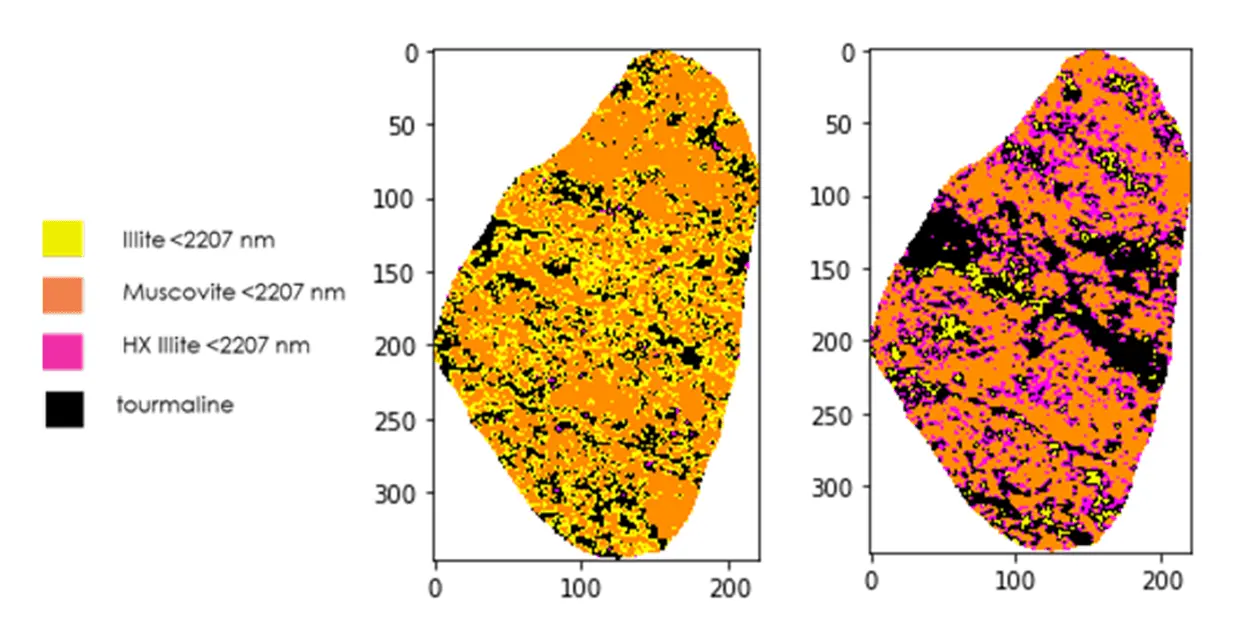
Recently, hybrid clustering algorithms gained much research attention due to better clustering resultsand are computationally efficient.Hyperspectral image classification studies should be no exception, including mineral mapping. This studyaims to tackle the biggest challenge of mapping the mineralogy of drill core samples, which consumes a lot of time.In this paper, we present the investigation using a hybrid clustering algorithm, cohesion-based self-merging (CSM), for mineral mapping to determine the number and location of minerals that formed the rock. The CSM clustering performance was then compared to its classical counterpart, K-means plus-plus (K-means++). We conducted experimentsusinghyperspectral imagesfrom multiple rock samples to understand how well the clustering algorithm segmentedminerals that exist inthe rock. The samples in this study contain minerals with identical absorption features in certain locations that increase the complexity. The elbow method and silhouette analysis did not perform well in deciding the optimum cluster sizedue to slight variance and high dimensionality of the datasets. Thus, iterations to the various numbersof 푘-clustersand 푚-subclustersof each rock wereperformed toget the mineral cluster. Both algorithms were able to distinguish slight variations of absorption features of any mineral.
The spectral variation within a single mineral found by our algorithm might be studied further to understand any possible unidentified group of clusters. The spatial consideration of the CSM algorithm induced several misclassified pixels. Hence, the mineral maps produced in this study are not expected to be precisely similar to ground truths.